Instutional Development Plan (IDP)
Instutional Development Plan (IDP)
Vision
To become a centre of excellence in Commerce and Science through innovation, skill-based learning, and societal growth.
Mission
Deliver value-based, learner-centered education; promote research and entrepreneurship; ensure holistic student development; strengthen industry and community partnerships.
Core Values
Excellence, Integrity, Inclusivity, Innovation, Social Responsibility, Sustainability.

- Governance & Leadership
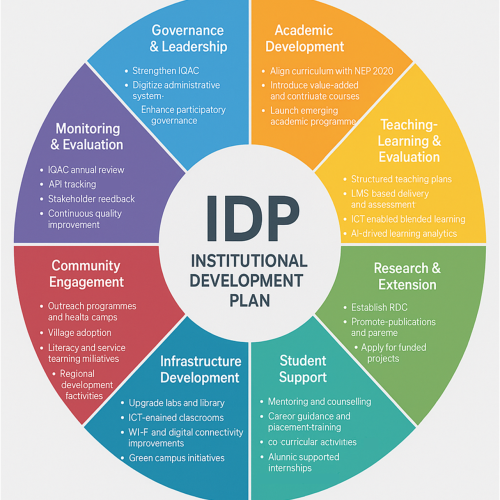
The institution aims to strengthen its governance framework by enhancing the functioning of IQAC, digitizing administrative procedures, and nurturing leadership capabilities across all levels. A participatory governance model will be promoted through transparent policy frameworks and stakeholder-driven decision-making. Continuous quality improvements will support the long-term goal of achieving a higher NAAC grade and eventually attaining academic autonomy.
- Academic Development
Academic excellence will be advanced by aligning programmes with NEP 2020 guidelines and introducing value-added and skill-oriented courses. The college will launch new programmes in emerging domains and establish a dedicated Skill Development Centre to enhance student employability. Industry partnerships, blended learning practices, and global collaborations will be expanded to ensure contemporary, relevant, and future-ready academics.
- TEACHING–LEARNING & EVALUATION
A structured academic ecosystem will be implemented through well-designed teaching plans, LMS integration, and continuous assessment mechanisms. The institution will promote ICT-enabled teaching, experiential activities, and blended learning models to enrich student engagement. Future initiatives include shifting toward AI-driven academic analytics and establishing a fully digital learning environment that supports personalized learning.
- RESEARCH & EXTENSION
Research culture will be strengthened by establishing a Research Development Cell (RDC), encouraging faculty publications, and promoting patentable innovations. The institution will actively pursue funded research projects and develop an Innovation & Startup Cell to support entrepreneurial initiatives. Long-term collaborations with industries, research organizations, and NGOs will be cultivated to enhance societal impact and applied research.
- STUDENT SUPPORT
Student development will be prioritized through comprehensive mentoring, psychological counseling, and career guidance services. Placement activities will be expanded, along with increased participation in NSS, YRC, sports, and co-curricular engagements. Alumni networks will be strengthened to support internships, mentoring, and training, with a strategic aim of achieving a 90% placement rate.
- INFRASTRUCTURE DEVELOPMENT
Institutional infrastructure will be upgraded through modern laboratories, digital classrooms, enhanced ICT facilities, and campus-wide high-speed Wi-Fi. Future expansions will include new academic blocks, green campus initiatives, and advanced research laboratories. A state-of-the-art incubation centre and smart digital library will be developed to support innovation, research, and academic excellence.
- FINANCE & RESOURCE MOBILIZATION
Revenue generation will be expanded through certificate courses, consultancy services, and professional training programmes. The institution will actively pursue CSR support, alumni contributions, and government-funded initiatives. Long-term financial sustainability will be strengthened by establishing endowments and working toward financial autonomy through diversified income sources.
- COMMUNITY ENGAGEMENT
The institution will continue to contribute to society through outreach programmes, health and wellness camps, and literacy initiatives. Service-learning will be integrated into the curriculum to connect students with real community needs. The college aims to become a regional centre for community development through village adoption schemes and continuous collaboration with local organisations.
- MONITORING & EVALUATION
Progress of the IDP will be reviewed annually through the IQAC, using clearly defined Key Performance Indicators (KPIs) and the Academic Performance Index (API). Feedback from students, faculty, alumni, and industry will guide ongoing improvements. Continuous quality enhancement will be ensured through systematic review processes aligned with NAAC norms and best practices.